Book Appointment Now

Microsuction vs Irrigation: Which Ear Wax Removal Method Is Best?
When comparing Microsuction vs Irrigation, many people only start looking into ear wax removal once their hearing becomes muffled, their ears feel blocked, or sounds seem dull and distant. Ear wax build up is extremely common, and professional removal is often the safest solution. The two most widely used clinical methods are microsuction and ear irrigation. While both aim to remove ear wax, they work in very different ways, and one is usually safer and more suitable than the other depending on your ear health, wax type, and medical history.
This guide to Microsuction vs Irrigation explains how each method works, their benefits and risks, and which option is generally considered the best method for ear wax removal, based on guidance from trusted medical bodies such as the NHS and ENT UK.
What Is Microsuction?
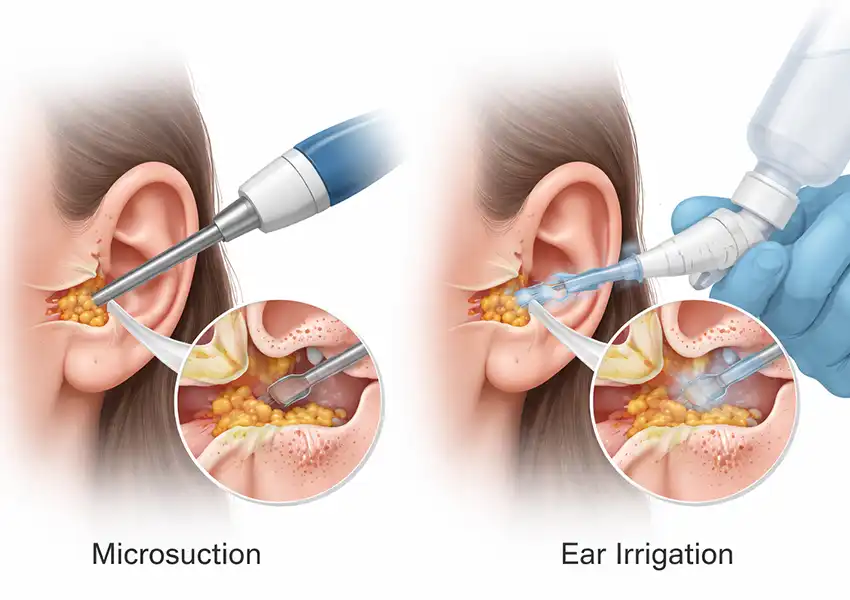
Microsuction is a modern clinical method of ear wax removal that uses a small suction device to gently remove wax under direct visual guidance. A microscope or video otoscope allows the clinician to see inside the ear canal throughout the procedure, ensuring precision and safety. As no water is involved, microsuction is classed as a dry technique, reducing the risk of infection or irritation.
In discussions around Microsuction vs Irrigation, the NHS often highlights microsuction as the preferred option when irrigation is not suitable, particularly for people with perforated eardrums or existing ear conditions.
Microsuction ear wax removal is widely regarded as the gold standard. It is suitable for most patients, including those with previous ear surgery, ear infections, perforated eardrums, or very hard and impacted wax. The procedure is usually quick, controlled, and highly effective.
What Is Ear Irrigation?
Ear irrigation is a traditional ear wax removal technique that uses warm water to flush wax out of the ear canal. A controlled stream of water is directed into the ear after wax has usually been softened with drops over several days.
When looking at Microsuction vs Irrigation, ear irrigation can still be effective for some patients. The British Tinnitus Association explains that irrigation may work well for softer wax but is not suitable for everyone, especially those with a history of ear problems.
Ear irrigation is generally recommended only for people with healthy ears, no history of ear surgery, and an intact eardrum. It is less effective for hard or impacted wax, which often makes microsuction the better choice.
Microsuction vs Irrigation: Key Differences
The main difference in Microsuction vs Irrigation lies in control and suitability. Microsuction allows the clinician to see exactly what they are doing throughout the procedure, offering greater precision. Ear irrigation relies on water pressure to dislodge wax, which makes it less controlled and dependent on the condition of the ear.
Microsuction is a dry method, making it safer for people prone to ear infections or irritation. Ear irrigation introduces moisture into the ear canal, which can occasionally cause dizziness or discomfort.
ENT UK advises that irrigation should only be used when the ear is healthy and the eardrum is fully intact, which further highlights why microsuction is often preferred in Microsuction vs Irrigation comparisons.
Which Method Is More Comfortable?
In most Microsuction vs Irrigation comparisons, microsuction is considered more comfortable. Patients may hear suction noise, but the sensation is usually mild and brief. Because the clinician works with direct visibility, the procedure is often faster and smoother.
Ear irrigation can also be comfortable for patients with soft wax. However, some people find the sensation of water in the ear unpleasant or disorientating, particularly if the wax has not been fully softened beforehand.
Which Method Is Safer?
Safety is one of the most important factors when weighing up Microsuction vs Irrigation. Microsuction is generally considered the safer method because it avoids water, lowers infection risk, and allows constant visual monitoring of the ear canal.
NICE clinical guidance supports microsuction when irrigation is contraindicated or unsuitable.
Ear irrigation can be safe in patients with healthy ears, but it is not recommended for those with perforated eardrums, ear infections, or previous ear surgery. There is also a small risk of temporary dizziness caused by water pressure.
Which Method Is Best for Hard or Impacted Wax?
When it comes to Microsuction vs Irrigation for hard or impacted wax, microsuction is clearly more effective. The clinician can directly target and remove wax even when it is tightly packed. Irrigation often struggles unless wax has been softened for several days beforehand.
For patients with recurring or stubborn wax build up, microsuction is usually the best method for ear wax removal.
Which Method Is Best for Soft Wax?
In Microsuction vs Irrigation discussions involving soft wax, both methods can be effective. Ear irrigation can work well when wax is soft and has been treated with drops. Microsuction also removes soft wax efficiently, making it suitable in almost all cases.
Microsuction vs Irrigation: Which Is Better Overall?
Overall, Microsuction vs Irrigation comparisons tend to favour microsuction as the safer and more versatile option. Microsuction is suitable for a wider range of ear conditions, works on all types of wax, and offers greater precision and control. Ear irrigation still has its place for patients with soft wax and healthy ears, but it is more limited in suitability.
If you are unsure which option is right for you, a professional ear examination is the best first step. A trained clinician can assess your ears and advise whether microsuction or irrigation is the safest and most effective choice.